
Histopathological Patterns of Endometrial Samples among Women with Abnormal Uterine Bleeding
DOI:
https://doi.org/10.64554/nujms.2026.2.2.2Keywords:
Abnormal uterine bleeding, Endometrial biopsy, Endometrial histopathology, Histopathological patterns, Endometrial hyperplasia, Endometrial cancer, Endometrial polyps, Age distribution, Endometrial carcinomaAbstract
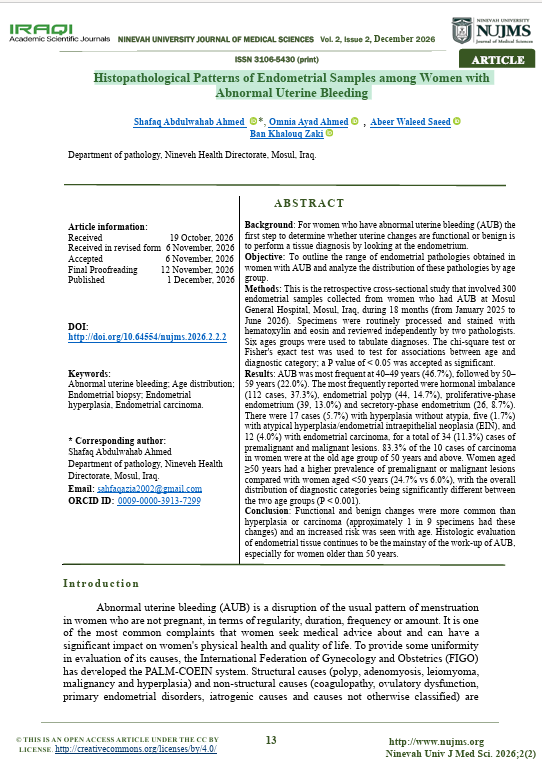
Background: In women with abnormal uterine bleeding (AUB), the most important way to distinguish non-neoplastic functional variations from pre-malignant and malignant endometrial lesions is through diagnostic evaluation of the endometrium.
Objective: To see the range of pathological diagnoses seen in endomesterial biopsies from women presenting with AUB and to understand their age distribution.
The methods used were descriptive cross-sectional study of 300 patients with AUB who received endometrial biopsies from Al-Mosul General Hospital in Mosul, Iraq, between January 2025 and June 2026. Tissues were routinely processed, paraffin embedded and stained with Hematoxylin and Eosin (H&E). Histopathological diagnosis was grouped according to the diagnostic criteria and data analyzed as absolute frequencies and percentages within the different age groups.
Results: The abnormal uterine bleeding was highest in the fifth decade, 46.67% (40-49 years), and secondly in the sixth decade 22% (50-59 years). The most common histological pattern was functional hormonal abnormalities (112 cases, 37.33%), followed by endometrial polyps (44 cases, 14.67%), proliferative endometriosis (39 cases, 13.00%) and secretory endometriosis (26 cases, 8.67%). Premalignant lesions and malignant lesions each represented 11.33% of all cases with atypical hyperplasia (17 cases; 5.67%) and atypical hyperplasia (5 cases; 1.67%) and endometrial cancer (12 cases; 4.00%). Notably, 90% (75/87) of any malignant diagnoses were made in women 50 years and older.
Discussion: Most cases of abnormal uterine bleeding are not associated with cancer but with non-cancerous, normal changes in the hormones. The risk of developing endometrial hyperplasia and endometrial cancer goes up with age. Endometrial biopsy is still necessary for histological diagnosis in pre- and post-menopausal women.
Downloads
References
1. Munro MG, Critchley HOD, Broder MS, Fraser IS; FIGO Working Group on Menstrual Disorders. FIGO classification system (PALM-COEIN) for causes of abnormal uterine bleeding in nongravid women of reproductive age. Int J Gynaecol Obstet. 2011;113(1):3-13. doi:10.1016/j.ijgo.2010.11.011.
2. Munro MG, Critchley HOD, Fraser IS; FIGO Menstrual Disorders Committee. The two FIGO systems for normal and abnormal uterine bleeding symptoms and classification of causes of abnormal uterine bleeding in the reproductive years: 2018 revisions. Int J Gynaecol Obstet. 2018;143(3):393-408. doi:10.1002/ijgo.12666.
3. Cree IA, White VA, Indave BI, Lokuhetty D. Revising the WHO classification: female genital tract tumours. Histopathology. 2020;76(1):151-156. doi:10.1111/his.13977.
4. Kareem NM, Mousa ET, Al-Rawaf SA. Histopathological findings in endometrial biopsies for a sample of Iraqi women with abnormal uterine bleeding. Ann Trop Med Public Health. 2020;23(5):329-335.
5. Kadhim FA, Almanadi FTA. The histopathological features of endometrial tissue specimens in women with peri and post-menopausal bleeding in Hillah City, Iraq. Iraqi J Sci. 2026;67(5):2698-2705. doi:10.24996/ijs.2026.67.5.16.
6. Husain S, Al Hammad RS, Alduhaysh AK, AlBatly AM, et al. Pathological spectrum of endometrial biopsies in Saudi women with abnormal uterine bleeding: a retrospective study of 13 years. Saudi Med J. 2021;42(3):270-279. doi:10.15537/smj.2021.42.3.20200814.
7. Riaz R, Sarfraz T, Riaz S, Aneeqa S, Wahid Y, Afzal S. Histological analysis and comparison of endometrial sampling and hysterectomy specimen in patients with abnormal uterine bleeding. Pak Armed Forces Med J. 2025;75(5):886-890. doi:10.51253/pafmj.v75i4.10883.
8. Latifi H, Gashi AM, Latifi D. The prevalent cases of endometrial carcinoma in different life periods of women: clinical and histopathological diagnosis. Curr Health Sci J. 2023;49(2):151-155. doi:10.12865/CHSJ.49.02.151.
9. Alshdaifat EH, Al-Horani SS, Al-Sous MM, Al-Horani AS, Sahawneh FE, Sindiani AM. Histopathological pattern of endometrial biopsies in patients with abnormal uterine bleeding in a tertiary referral hospital in Jordan. Ann Saudi Med. 2022;42(3):204-213. doi:10.5144/0256-4947.2022.204.
10. Vijayaraghavan A, Jadhav C, Pradeep B, Bindu H, Kumaran S, Pradeep BK, et al. A histopathological study of endometrial biopsy samples in abnormal uterine bleeding. Cureus. 2022;14(11):e31264. doi:10.7759/cureus.31264.
11. Karimi M, Alizadeh A, Mahmoodi M. Clinicopathological pattern of endometrial specimens in women with abnormal uterine bleeding and ultrasonography correlation. Arch Iran Med. 2024;27(4):216-222. doi:10.34172/aim.2024.31.
12. Doherty MT, Sanni OB, Coleman HG, Cardwell CR, McCluggage WG, Quinn D, et al. Concurrent and future risk of endometrial cancer in women with endometrial hyperplasia: a systematic review and meta-analysis. PLoS One. 2020;15(4):e0232231. doi:10.1371/journal.pone.0232231.
13. Vitale SG, Buzzaccarini G, Riemma G, Pacheco LA, Di Spiezio Sardo A, Carugno J, et al. Endometrial biopsy: indications, techniques and recommendations. An evidencebased guideline for clinical practice. J Gynecol Obstet Hum Reprod. 2023;52(6):102588. doi:10.1016/j.jogoh.2023.102588.
14. Concin N, Matias-Guiu X, Vergote I, Cibula D, Mirza MR, Marnitz S, et al. ESGO/ESTRO/ESP guidelines for the management of patients with endometrial carcinoma. Int J Gynecol Cancer. 2021;31(1):12-39. doi:10.1136/ijgc-2020-002230.
Downloads
Published
Issue
Section
License
Copyright (c) 2026 Ninevah University Journal of Medical Sciences

This work is licensed under a Creative Commons Attribution 4.0 International License.