
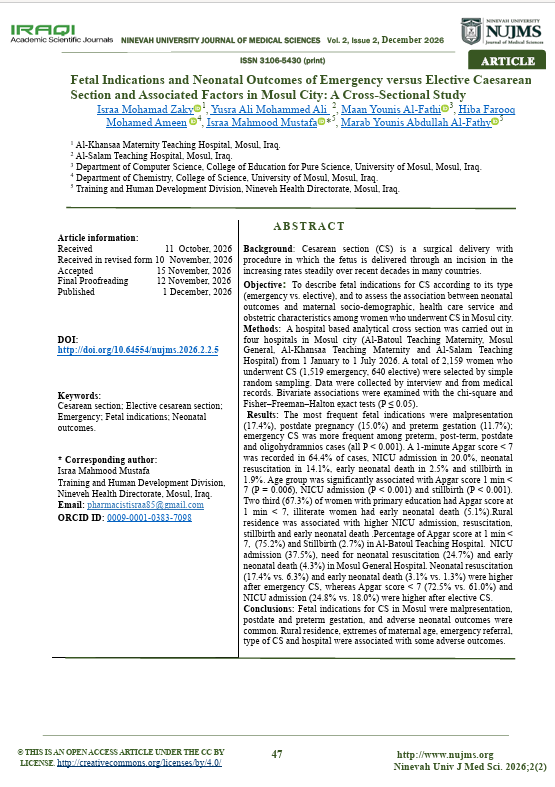
Fetal Indications and Fetal Outcomes of Emergency versus Elective Cesarean Section and Their Associated Factors in Mosul City
DOI:
https://doi.org/10.64554/Keywords:
Emergency Cesarean; Fetal causes; Neonatal morbidity.Abstract
Abstract:
Background: Cesarean section lifesaving procedure for mothers and /or fetus although has indication for it such as fetal malpresentation, preterm and oligohydramnios, etc., but at same time carried several adverse outcomes.
Objectives: To describe fetal indications for CS according to its type, and to assess the association between fetal outcomes and maternal socio-demographic, health care service and obstetric characteristics among women who underwent CS in Mosul city.
Methods: A cross-sectional study was conducted in four hospitals in Mosul city (Al-Batoul Teaching Maternity, Mosul General, Al-Khansaa Teaching Maternity and Al-Salam Teaching) from 1 January to 1 July 2026. A total of 2159 women who underwent CS (1519 emergency, 640 elective) were selected by simple random sampling. Data were collected by interview and from medical records using closed ended question. Chi-square test and Fisher–Freeman–Halton exact test was used; P ≤ 0.05 was considered significant.
Result: Fetal indications for CS are malpresentation (17.4%), postdate (15.0%) and preterm (11.7%). Age group was significantly associated with Apgar score 1 min < 7 (P = 0.006), NICU admission (P < 0.001) and stillbirth (P < 0.001). Two third (67.3%) of women with primary education had Apgar score at 1 min < 7, illiterate women had early neonatal death (5.1%). Residence was significantly associated with all outcome. Percentage of Apgar score at 1 min < 7, (75.2%) and Stillbirth (2.7%) in Al-Batoul Teaching Hospital. NICU admission (37.5%), need for neonatal resuscitation (24.7%) and early neonatal death (4.3%) in Mosul General Hospital. Previous scar had significant statistical association with all fetal outcomes. The type of CS was significantly associated with Apgar score 1 min < 7, NICU admission, neonatal resuscitation and early neonatal death. Apgar score at 1 min < 7 (72.5% vs. 61.0%) and NICU admission (24.8% vs. 18.0%) were higher after elective CS, whereas neonatal resuscitation (17.4% vs. 6.3%) and early neonatal death (3.1% vs. 1.3%) were higher after emergency CS
Conclusion: Fetal indications for CS in Mosul were dominated by malpresentation, postdate and preterm birth. Emergency CS more common among preterm and oligohydramnios cases. Adverse fetal outcomes were associated with rural residence, extremes of maternal age, emergency referral, type of CS and the hospital that required strengthening antenatal care, referral pathways and rural services.
Downloads
References
1- Thomaidi S, Sarantaki A, Tzitiridou Chatzopoulou M, Orovou E, Jotautis V, Papoutsis D. The Rising Global Cesarean Section Rates and Their Impact on Maternal and Child Health: A Scoping Review. J Clin Med. 2025 Nov 15;14(22):e8102. Doi 10.3390/jcm14228102.
2- Betran AP, Ye J, Moller AB, Souza JP, Zhang J. Trends and projections of caesarean section rates: global and regional estimates. BMJ Glob Health. 2021 Jun;6(6):e005671. https://gh.bmj.com/content/6/6/e005671.
3- Fadhl NN, Zubair OA, Al-Wazzan RM. Prevalence of Caesarean Sections in Mosul City Hospitals: A Cross–Sectional Study. Annals of the College of Medicine Mosul. 2020 Dec 1;42(2):126-32.URL: https://mmed.uomosul.edu.iq/index.php/mmed/article/view/37320.
4- Chen L. Cesarean Section Indication and Perinatal Outcomes of Infants With Macrosomia in Primiparous Women: A Retrospective Cohort Study. Clinical and Experimental Obstetrics & Gynecology. 2025 Dec 23;52(12): 42782-9 URL: https://www.imrpress.com/journal/CEOG/52/12/10.31083/CEOG42782.
5- Saha L, Ghorabah M, Hozayan RF, Ibrahim N, Abozenah Y, El-Hasan N. Pregnancy Outcomes Following Planned Cesarean Section: Experience From a Tertiary Care Hospital in Bahrain. Cureus. 2025 Jun 29;17(6): e86994. URL: https://www.cureus.com/articles/371527-pregnancy-outcomes-following-plannedcesarean-section-experience-from-a-tertiary-care-hospital-in-bahrain.pdf.
6- Shirin H, Ehsanul HKATM, Hawlader MDH, Masud SB, Misty K, Dewan F, Moriyama M. Effectiveness of WHO-Recommended Antenatal Care Visits, Ultrasonography, and Health Education in Reducing Unnecessary Caesarean Sections among Pregnant Women in Bangladesh: A Hospital-Based Randomised Controlled Trial. J Glob Health. 2025;15:04182. Doi 10.7189/jogh.15.04182
7- Khalaf Allah E, Abdelwahid A, Daoud I, Saaed IA, Abbas N, Gurashi A, Abuobida B, Elrasheed FE, Mohamed M. Neonatal Outcomes Following Emergency versus Elective Primary Cesarean Section: A Cross-Sectional Study among Sudanese Women, Khartoum. Perinat J. 2025;33(2):158-165. https://www.perinataljournal.com/content/pdf/v33i2/Article19.pdf
8- Vijayan J, Mishra N, Kumar A, Ahuja A. Prospective Comparative Study on the Relationship between Adverse Maternal and Fetal Outcomes and the Total Number of Antenatal Visits: Evaluating the Focused Ante Natal Care Model and Assessment of Prenatal Care Utilization Index. Oman Med J 2026 Jan 31;41(1):e798. Doi 10.5001/omj.2025.109.
9- Idress NH, Ibrahim RM, Younis NM. Mode of delivery and its influences on neonatal morbidity among newly born babies at maternity teaching hospitals in Mosul City: A comparison study. J Educ Health Promot. 2025 Nov 28;14:470. Doi 10.4103/jehp.jehp_1756_24.
10- Abdulnabi SF, Mohammadi M, Jabbari A, Ghorbani S, Nikpayam O, Flaifel HA. A Comparative Study of Maternal and Neonatal Outcomes in Obese and Non-obese Iraqi Pregnant Women Undergoing Cesarean Section. Cureus. 2025 Mar 23;17(3): e81039. Doi:10.7759/cureus.81039.
11- Ahmed AA, Ahmed AA, Salman ST. Assessing the burden of cesarean deliveries in Diyala, Iraq: incidence, underlying factors, and health implications for mothers and infants. Int J Health Med. 2025;2(3):34-43. Doi 10.62951/ijhm.v2i3.412.
12- Boateng GO, Neilands TB, Frongillo EA, Melgar-Quiñonez HR, Young SL. Best practices for developing and validating scales for health, social, and behavioral research: a primer. Front Public Health 2018 Jun 11;6:149. https://doi.org/10.3389/fpubh.2018.00149.
13- Bolarinwa OA. Principles and methods of validity and reliability testing of questionnaires used in social and health science researches. Niger Postgrad Med J. 2015 Oct 1;22(4):195201. Doi 10.4103/1117-1936.173959.
14- Abdullah RY, Mohammed Ali HR. Trends and medical indications of cesarean section in the public health sector. BioMed Target J. 2025;3(1):57-68. Doi:10.59786/bmtj.315
15- Milani F, Sharami SH, Attari SM, Rafiee Sorouri Z, Farzadi S, Kazemi S. Factors associated with cesarean section in preterm births at a tertiary hospital in Rasht, Iran. J Kermanshah Univ Med Sci. 2024;28(2):e144362. Doi:org/10.5812/jkums-144362.
16- Sawant AA, Wankhede S, Thakare S, Narayan GN, Saha I, Vernekar A. Maternal and perinatal outcomes in oligohydramnios: a cross-sectional analysis of pregnancies between 28 to 42 weeks of gestation. Cureus. 2025;17(2):e79232. https://pubmed.ncbi.nlm.nih.gov/40115693/.
17- Mussa I, Debella A, Regassa LD, Ahamed B, Jibro U, Eyeberu A. Rate of cesarean section among breech deliveries in Ethiopia: a systematic review and meta-analysis. Front Surg. 2024;11:1283965. Doi: 10.3389/fsurg.2024.1283965/full.
18- Amin KM. Pregnancy outcome in pregnant women with idiopathic polyhydramnios. AlRafidain J Med Sci. 2025;8(2):231-7. https://ajms.iq/index.php/ALRAFIDAIN/article/view/2000.
19- Wahabi H, Fayed A, Aleyeidi N, Esmaeil S. Epidemiology of macrosomia in Saudi Arabia: an analysis of 12,045 pregnancies from the Riyadh Mother and Baby Multicenter Cohort Study (RAHMA) database. Healthcare (Basel). 2024;12(24):2514. Doi:22279032/12/24/2514.
20- Okot G, Omara S, Kasujja M, Pebalo FP, Baruti P, Almenares NU. Incidence and factors associated with immediate adverse neonatal outcomes among emergency obstetric referrals in labor at a tertiary hospital in Uganda: a prospective cohort study. BMC Pregnancy Childbirth. 2024;24(1). https://link.springer.com/article/10.1186/s12884-02406900-6.
21- Bharati S, Dangal G, Tiwari KD, Maharjan S, Bhandari S, Karki A, et al. Fetomaternal outcome of pregnant women at term undergoing cesarean section. J Nepal Health Res Counc. 2024;22(1):21-4. Doi: org/10.33314/jnhrc.v22i01.4599.
22- Khasawneh W, Obeidat N, Yusef D, Alsulaiman JW. The impact of cesarean section on neonatal outcomes at a university-based tertiary hospital in Jordan. BMC Pregnancy Childbirth. 2020;20(1). Doi:10.1186/s12884-020-03027-2.
23- Nyongesa P, Ekhaguere OA, Marete I, Tenge C, Kemoi M, Bann CM, et al. Maternal age extremes and adverse pregnancy outcomes in low-resourced settings. Front Glob Womens Health. 2023;4:1201037. Doi:10.3389/fgwh.2023.1201037.
24- Abebe YM, Deribe L, Fantahun A, Beyene BN, Megule SM, Shiferaw WG, et al. Advanced maternal age increases the risk of adverse neonatal outcomes: a comparative study in Ethiopia. BMC Pregnancy Childbirth. 2025;25(1):1144. Doi:10.1186/s12884-025-083162.
25- Parajuli S, Poudyal JK, Poudel MM, Regmi K, Adhikari P. Risk factors and birth outcomes associated with adolescent pregnancy in tertiary level hospital of Chitwan. J Bharatpur
Hosp. 2025;1(1):24-32. https://www.nepjol.info/index.php/jobh/article/view/78505.
26- Rafaat BM, Shakoor JA. Maternal age and adverse pregnancy outcomes among women attended Kirkuk city hospitals: a comparative study. Kufa J Nurs Sci. 2023;13(2):25966. Doi:org/10.36321/kjns.vi20232.13301.
27- Neamin T, Frehiwot L, Mandefro K, Fitsum W. Determinants of stillbirth among reviewed perinatal deaths in Ethiopia. Front Pediatr. 2022;10:1030981. Doi:10.3389/fped.2022.1030981.
28- Damtew BS, Gudayu TW, Temesgan WZ, Hailu AM. Effect of decision-to-delivery time of emergency cesarean section on adverse newborn outcomes at East Gojjam Zone public hospital, Ethiopia, March 2023: multicenter prospective observational study design. Int J Womens Health. 2024;16:433-50. Doi:10.2147/IJWH.S451101?needAccess=true.
29- Demissie KA, Jejaw M, Wondimu BG, Mersha YT, Demsash ES, Dessie SG, et al. Only 9% of mothers have eight and more ANC visit in 14 sub-Saharan African countries; evidence from the most recent DHS 2018-2023: a multilevel analysis. BMC Public Health. 2024;24:1631. Doi:10.1186/s12889-024-19145-x.
30- Abebaw N, Negesse Y, Begashw A, Amare D, Tsegaw G, Meshesha D, et al. Prevalence and associated factors of eight antenatal care contacts among mothers who give birth in Shebel Berenta district, East Gojjam zone, northeast Ethiopia, 2024. Front Reprod Health. 2025;7:1531380. Doi:10.3389/frph.2025.1531380/full.
31- Almalki A, Alkhamis WH, Alzaydan O, Bogis A, Bassi A, Sabr Y. Maternal and neonatal morbidity and mortality among multiple repeat caesarean deliveries. Clin Exp Obstet Gynecol. 2026;53(3):47798. https://www.imrpress.com/journal/CEOG/53/3/10.31083/CEOG47798.
32- Çiçekli N, Vural NA, Kıran G. Comparison of maternal and fetal outcomes in emergency and elective cesarean sections: a retrospective study. Kocatepe Med J. 2025;26(3):190-5. https://dergipark.org.tr/en/pub/kocatepetip/article/1531925.
33- Bham SQ, Khan KMA. Impact of rising elective cesarean section rates on early neonatal outcome: elective cesarean section and neonatal outcome. Pak J Med Dent. 2024;13(3):3846. Doi:10.36283/PJMD13-3/006.
34- Arvaniti A, Papachatzi E, Magriplis E, Antonakopoulos N, Antonakis L, Dimitriou G, et al. Late-preterm and early-term respiratory morbidity in infants born primarily via elective caesarean section. J Clin Med. 2026;15(1):126. Doi:10.3390/jcm15010126.
Downloads
Published
Issue
Section
License
Copyright (c) 2026 Ninevah University Journal of Medical Sciences

This work is licensed under a Creative Commons Attribution 4.0 International License.