
Assessment Of Serum Level Of Catalase, Ceruloplasmin And Advance Oxidative Protein Product In Uterine Fibroid
DOI:
https://doi.org/10.64554/nujms.2026.2.2.1Keywords:
Uterine fibroids, oxidative stress, advanced oxidative protein productAbstract
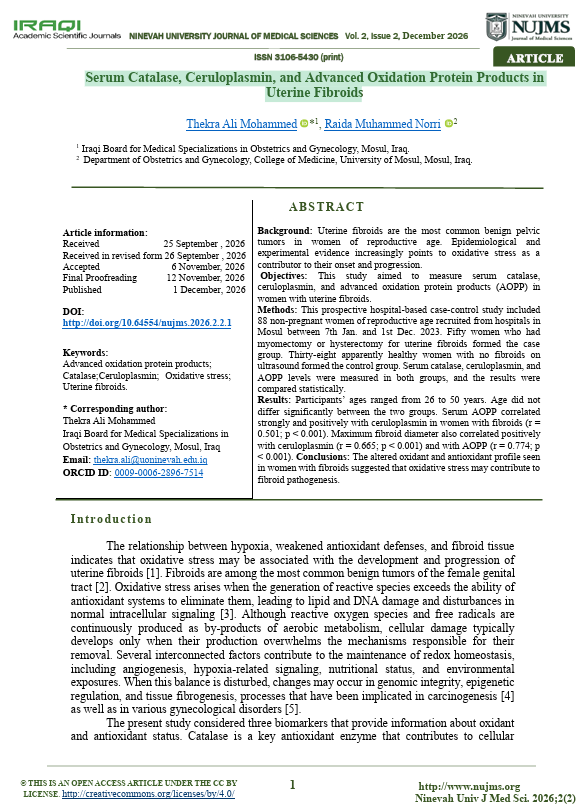
Background: Uterine fibroids are the most common benign pelvic tumors in women of reproductive age. Epidemiological and experimental evidence increasingly points to oxidative stress as a contributor to their onset and progression. Objectives: This study aimed to measure serum catalase, ceruloplasmin, and advanced oxidation protein products (AOPP) in women with uterine fibroids. Methods: This prospective hospital-based case-control study included 88 non-pregnant women of reproductive age recruited from hospitals in Mosul between 7th Jan. and 1st Dec. 2023. Fifty women who had myomectomy or hysterectomy for uterine fibroids formed the case group. Thirty-eight apparently healthy women with no fibroids on ultrasound formed the control group. Serum catalase, ceruloplasmin, and AOPP levels were measured in both groups, and the results were compared statistically. Results: Participants’ ages ranged from 26 to 50 years. Age did not differ significantly between the two groups. Serum AOPP correlated strongly and positively with ceruloplasmin in women with fibroids (r = 0.501; p < 0.001). Maximum fibroid diameter also correlated positively with ceruloplasmin (r = 0.665; p < 0.001) and with AOPP (r = 0.774; p < 0.001). Conclusions: The altered oxidant and antioxidant profile seen in women with fibroids suggested that oxidative stress may contribute to fibroid pathogenesis.
Downloads
References
1. Tal R, Segars JH. The role of angiogenic factors in fibroid pathogenesis: potential implications for future therapy. Hum Reprod Update. 2014;20(2):194-216. doi: 10.1093/humupd/dmt042.
2. Stewart EA, Laughlin-Tommaso SK, Catherino WH, et al. Uterine fibroids. Nat Rev Dis Primers. 2016;2:16043. doi: 10.1038/nrdp.2016.43.
3. AlAshqar A, Lulseged B, Mason-Otey A, et al. Oxidative stress and antioxidants in uterine fibroids: pathophysiology and clinical implications. Antioxidants (Basel). 2023;12(4):807. doi: 10.3390/antiox12040807.
4. Sies H. Oxidative stress: concept and some practical aspects. Antioxidants (Basel). 2020;9(9):852. doi: 10.3390/antiox9090852.
5. Xue T, Qiu X, Liu H, et al. Epigenetic regulation in fibrosis progress. Pharmacol Res. 2021;173:105910. doi: 10.1016/j.phrs.2021.105910.
6. Ransy C, Vaz C, Lombès A, et al. Use of H2O2 to cause oxidative stress, the catalase issue. Int J Mol Sci. 2020;21(23):9149. doi: 10.3390/ijms21239149.
7. Chen S, Li J, Vinothkumar KR, et al. Interaction of human erythrocyte catalase with air-water interface in cryoEM. Microscopy (Oxf). 2022;71(Suppl 1). doi: 10.1093/jmicro/dfab037.
8. Goodchild CG, DuRant SE. Fluorescent heme degradation products are biomarkers of oxidative stress and linked to impaired membrane integrity in avian red blood cells. Physiol Biochem Zool. 2020;93(2):129-139. doi: 10.1086/707920.
9. Szubert M, Koziróg E, Olszak O, et al. Adenomyosis and infertility: review of medical and surgical approaches. Int J Environ Res Public Health. 2021;18(3):1235. doi: 10.3390/ijerph18031235.
10. Skalnaya MG, Skalny AV. Essential trace elements in human health: a physician's view. Tomsk: Tomsk State University Publishing House; 2018.
11. Harris ZL. Ceruloplasmin. In: Kerkar N, Roberts EA, editors. Clinical and translational perspectives on Wilson disease. Academic Press; 2019. p. 77-84. doi: 10.1016/B978-012-810532-0.00009-4.
12. Marchi G, Busti F, Lira Zidanes A, et al. Aceruloplasminemia: a severe neurodegenerative disorder deserving an early diagnosis. Front Neurosci. 2019;13:325. doi: 10.3389/fnins.2019.00325.
13. Gryszczyńska B, Formanowicz D, Budzyń M, et al. Advanced oxidation protein products and carbonylated proteins as biomarkers of oxidative stress in selected atherosclerosis-mediated diseases. Biomed Res Int. 2017;2017:4975264. doi: 10.1155/2017/4975264.
14. Liu J, Wen S, Lin Y, et al. Advanced oxidation protein products change biological behaviors of rat endometrial epithelial cells by activating ERK/P38 signaling pathways. Biol Open. 2020;9(5). doi: 10.1242/bio.048876.
15. Villalpando Sánchez DC, Alvarez Aguilar C, Gómez García A. Advanced oxidation protein products and their relationship with cardiovascular risk factors in young apparently healthy people. Clin Investig Arterioscler. 2017;29(5):209-215. doi: 10.1016/j.arteri.2017.04.004.
16. Santulli P, Borghese B, Lemaréchal H, et al. Increased serum oxidative stress markers in women with uterine leiomyoma. PLoS One. 2013;8(8). doi: 10.1371/journal.pone.0072069.
17. Cetinkaya K, Aribal Ayral P, Cetinkaya S, et al. Level of certain oxidants and antioxidants in patients with uterine fibroids. Gynecol Obstet Reprod Med. 2019;25(3):158-162. doi: 10.21613/GORM.2019.955.
18. Millien C, Katz AM, Mukherjee J, et al. Uterine fibroid: a socially malignant illness in Haiti. Anthropol Med. 2022;29(3):255-270. doi: 10.1080/13648470.2022.2075319.
19. Soibi-Harry AP, Makwe CC, Oluwole AA, et al. Serum oxidative stress markers in women with uterine fibroids in Lagos, Nigeria [preprint]. medRxiv. 2021. doi: 10.1101/2021.07.07.21260056.
20. Dragomir AD, Schroeder JC, Connolly A, et al. Potential risk factors associated with subtypes of uterine leiomyomata. Reprod Sci. 2010;17(11):1029-1035. doi: 10.1177/1933719110376979.
21. Tai AS, Lin RT, Lin YC, et al. Genome-wide causal mediation analysis identifies genetic loci associated with uterine fibroids mediated by age at menarche. Hum Reprod. 2022;37(9):2197-2212. doi: 10.1093/humrep/deac136.
22. Arinkan SA, Serifoglu H. The possible association of uterine fibroid formation with copper intrauterine device use: a cross-sectional study. Clin Exp Obstet Gynecol. 2021;48(4):969-973. doi: 10.31083/j.ceog4804153.
23. Hartmann KE, Velez Edwards DR, Savitz DA, et al. Prospective cohort study of uterine fibroids and miscarriage risk. Am J Epidemiol. 2017;186(10):1140-1148. doi: 10.1093/aje/kwx062.
24. Song L, Shen L, Mandiwa C, et al. Induced and spontaneous abortion and risk of uterine fibroids. J Womens Health (Larchmt). 2017;26(1):76-82. doi: 10.1089/jwh.2016.5913.
25. Grune T, Sommerburg O, Siems WG. Oxidative stress in anemia. Clin Nephrol. 2000;53(1 Suppl).
26. Wang B, Wang XP. Does ceruloplasmin defend against neurodegenerative diseases? Curr Neuropharmacol. 2019;17(6):539-549. doi: 10.2174/1570159X16666180508113025.
27. Vural M, Camuzcuoglu H, Toy H, et al. Oxidative stress and prolidase activity in women with uterine fibroids. J Obstet Gynaecol. 2012;32(1):68-72. doi: 10.3109/01443615.2011.633718.
28. Mukhopadhyay CK, Mazumder B, Fox PL. Role of hypoxia-inducible factor-1 in transcriptional activation of ceruloplasmin by iron deficiency. J Biol Chem. 2000;275(28):21048-21054. doi: 10.1074/jbc.M000636200.
29. Helman SL, Zhou J, Fuqua BK, et al. The biology of mammalian multi-copper ferroxidases. Biometals. 2023;36(2):263-281. doi: 10.1007/s10534-022-00370-z.
30. Karabulut A, Alp Avci G, Avci E. Increased oxidative stress in adult women with iron deficiency anemia. Univ Med. 2022;41(1):29-36. doi: 10.18051/UnivMed.2022.v41.29-36.
31. Hussein RAM, Al-Salih RMH, Ali SAR. A study of prolactin, thyroid stimulating hormones, malondialdehyde and ceruloplasmin levels in infertile women, in Thi-Qar Governorate/Iraq. Thi-Qar Med J. 2017;14(2):14-21. doi: 10.32792/tmj.v14i2.34.
32. Bolzán AD, Bianchi MS, Bianchi NO. Superoxide dismutase, catalase and glutathione peroxidase activities in human blood: influence of sex, age and cigarette smoking. Clin Biochem. 1997;30(6):449-454. doi: 10.1016/S0009-9120(97)00047-7.
33. Amirkhizi F, Siassi F, Minaie S, et al. Is obesity associated with increased plasma lipid peroxidation and oxidative stress in women? ARYA Atheroscler. 2007;2(4):189-192.
34. Denko CW, Gabriel P. Age and sex related levels of albumin, ceruloplasmin, alpha1antitrypsin, alpha1-acid glycoprotein, and transferrin. Ann Clin Lab Sci. 1981;11(1):6368.
35. Cox DW. Factors influencing serum ceruloplasmin levels in normal individuals. J Lab Clin Med. 1966;68(6):893-904.
Downloads
Published
Issue
Section
License
Copyright (c) 2026

This work is licensed under a Creative Commons Attribution 4.0 International License.